
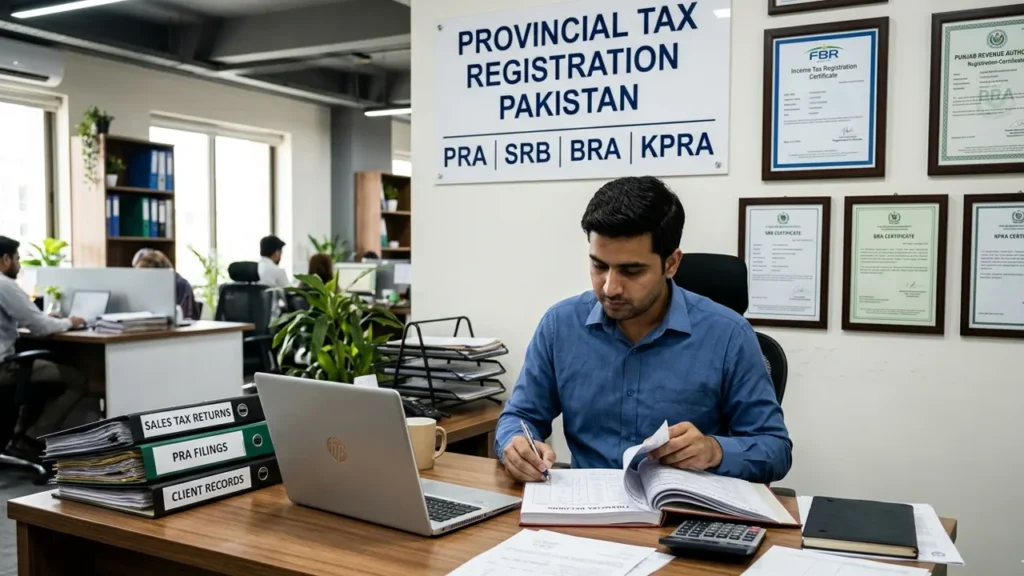
Why Most Businesses Get Provincial Tax Registration Wrong (And How to Fix It)
Most service businesses in Pakistan don’t realize they may need multiple tax registrations until a legal notice arrives at their door. Imagine a flourishing tech agency based in Lahore expanding its clientele to Karachi. They have their NTN Registration, so they assume they’re covered. However, the moment they invoice a client in Sindh without being registered with the SRB, they’ve unknowingly stepped into a compliance minefield.
The Maze of Multi-Authority Compliance
In Pakistan, the tax landscape isn’t a single path; it’s a crossroads. While the FBR handles goods, “sales tax on services” is governed by four distinct provincial bodies:
- PRA (Punjab Revenue Authority)
- SRB (Sindh Revenue Board)
- KPRA (Khyber Pakhtunkhwa Revenue Authority)
- BRA (Balochistan Revenue Authority)
Navigating these separate jurisdictions is the primary hurdle for modern service providers. Whether you are a consultant, a digital marketer, or a construction firm, understanding which door to knock on is the difference between seamless growth and heavy penalties.
What You’ll Learn in This Guide
This guide is designed to strip away the technical jargon and provide a clear roadmap for:
- Identifying which provincial authority governs your specific service.
- The step-by-step process of provincial sales tax registration in Pakistan.
- Maintaining compliance across borders to avoid double taxation.
4 Tax Authorities, 1 Confusion — Here’s What Each One Actually Does
Here’s where most businesses get confused: each province in Pakistan has its own tax authority. Following the devolution of powers under the 18th Amendment, the right to collect sales tax on services was transferred from the federal government to the provinces. This means your business doesn’t just “pay tax”—it pays the right authority based on where your service is rendered.
Expert Insight: Tax consultants often see businesses registering with the wrong authority or thinking an FBR registration covers everything. This mistake can lead to double taxation or heavy non-compliance penalties.
PRA (Punjab Revenue Authority)
The PRA governs the Punjab province. It is responsible for the administration and collection of sales tax on a vast range of services, from IT and consultancy to hospitality. If your business premises are in Punjab, or you provide services to clients within the province, the PRA is your primary regulator.
SRB (Sindh Revenue Board)
The SRB is the authority for the Sindh province. Known for being one of the most proactive tax bodies, it manages sales tax on services for Pakistan’s financial hub, Karachi, and the rest of Sindh. Registration is mandatory for any service provider operating within provincial limits.
KPRA (Khyber Pakhtunkhwa Revenue Authority)
Operating in the Khyber Pakhtunkhwa province, KPRA oversees the collection of provincial sales tax. It has recently expanded its reach to include a wider variety of digital and professional services to boost provincial revenue.
BRA (Balochistan Revenue Authority)
The BRA is the youngest of the four, governing sales tax on services within Balochistan. While its list of taxable services has historically been more focused on the industrial and energy sectors, it now covers most professional services provided in the region.
Who Needs Provincial Sales Tax Registration in Pakistan?
In Pakistan, any person or business entity providing taxable services listed in the respective provincial laws (the Second Schedule) must register for provincial sales tax. Unlike federal sales tax which focuses on goods, provincial registration is mandatory for service providers—ranging from IT consultants and digital agencies to salons and construction firms—operating within provincial territories.
Not sure if you even need registration? Here’s the quick answer: if you are providing services for a fee and your service category isn’t explicitly exempt, you likely need to register with the relevant authority (PRA, SRB, KPRA, or BRA).
Eligible Categories for Registration
- Service Providers: This includes traditional professionals like lawyers and accountants, as well as modern roles like digital marketers, software developers, and recruiters.
- Businesses with a Physical Presence: Any entity that owns, rents, or occupies a space in a province to carry out business activities.
- Cross-Provincial Operators: If you are based in Lahore (Punjab) but provide services to a client in Karachi (Sindh), you may be liable to register with both PRA and SRB depending on where the service is “consumed.”
- Withholding Agents: Even if you aren’t a service provider, you must register as a withholding agent if you are a company or public sector organization paying for taxable services.
Real-World Examples
- The Digital Agency: A software house in Lahore providing web development services to local clients must register with the PRA. If they open a branch in Karachi to serve Sindh-based clients, they must also register with the SRB.
- The Freelancer: Many freelancers assume they are exempt. However, if a freelancer provides “Management Consultancy” or “IT-enabled services” to local Pakistani clients and exceeds the provincial turnover threshold, registration is legally required.
Expert Insight: Many businesses mistakenly believe their FBR (Federal) registration covers everything. FBR is for goods and income; provincial authorities are strictly for services. Operating without the correct provincial “PST” number can lead to your invoices being rejected by corporate clients.
6 Steps to Get Registered Quickly (PST Registration)
The process of provincial sales tax registration in Pakistan is primarily digital, involving an online application through the relevant provincial portal, submission of scanned business documents, and a final verification by tax officers. While each authority (PRA, SRB, KPRA, BRA) has its own portal, the core workflow remains consistent across all provinces.
The process isn’t complicated—but one small mistake, like selecting the wrong service category or uploading an expired utility bill, can delay your registration by weeks.
1. Determine Your Correct Authority
Before starting, identify which province you are operating in. If you have offices in multiple provinces, you may need to register with each.
- Punjab: Punjab Revenue Authority (PRA)
- Sindh: Sindh Revenue Board (SRB)
- KPK: Khyber Pakhtunkhwa Revenue Authority (KPRA)
- Balochistan: Balochistan Revenue Authority (BRA)
2. Create a Portal Account
Visit the official e-portal of your authority and create a user ID. Most portals require your National Tax Number (NTN) or CNIC to start the “New Registration” process.
- Portal Hint: If you already have an NTN, use the “New e-Registration Having NTN” option to pull your existing data from the FBR database.
3. Prepare Required Documents
Scan and save clear PDF copies of your essential documents. This typically includes your CNIC, business letterhead, bank account maintenance certificate, and proof of business premises (rent agreement or ownership docs).
- Clarity Tip: Ensure your bank certificate explicitly mentions the business name as it appears on your NTN.
4. Submit the Online Application
Fill out the electronic form. You will need to select your “Service Category” (e.g., IT-enabled services, Management Consultants, etc.) from a drop-down menu.
- Expert Insight: Professionals often double-check service classification in the “Second Schedule” of the provincial act before submission to avoid rejection due to incorrect categorization.
5. Verification & Bio-metrics
Once submitted, the authority will review your application. Some provinces may require a physical visit to a facilitation center or a NADRA e-Sahulat center for biometric verification.
6. Issuance of Registration Certificate
After successful verification, the authority will issue your Provincial Sales Tax (PST) number. You can then download your registration certificate directly from the portal.
Document Checklist for Provincial Sales Tax Registration
Before you apply, make sure you have these documents ready—missing even one or providing an outdated record can delay your registration by weeks. While portals are automated, the verification process is rigorous.
Most provincial authorities (PRA, SRB, KPRA, and BRA) require a standard set of documents to verify your identity, business location, and legal status. A direct answer to your documentation needs involves three core categories: identity, premises, and banking.
The Essential Document Checklist
Personal & Identity Documents
- CNIC: Clear, scanned copies of the owner (Proprietor), all Partners (for AOP), or Directors (for Companies).
- National Tax Number (NTN): A copy of your FBR registration certificate or your 7-digit NTN.
- Contact Details: An active mobile number and email address (must be accessible for OTP verification).
Business & Legal Documents
- Business Letterhead: A digital copy of your official letterhead (crossed or stamped).
- Registration Proof: * For Companies: SECP Incorporation Certificate, Form 21, and Form 29.
- For AOPs: Partnership Deed and Form H.
- Description of Services: A brief summary of your business activities to help with service classification.
Address & Premises Verification
- Utility Bill: A paid electricity or gas bill for the business premises (not older than 3 months).
- Proof of Possession:
- If Rented: A valid, signed Rent Agreement/Lease Deed.
- If Owned: Property ownership documents or “Fard” copy.
- Premises Photos: Some authorities (like SRB) may require photos of the office exterior and interior.
Bank Account Details
- Account Maintenance Certificate: An official letter from your bank confirming the account title, number, and business name.
- Bank Statement: The most recent statement for all operational accounts related to the business.
Document Types vs. Purpose
| Document | Primary Purpose | Authority Focus |
| CNIC / NTN | Identity Verification | Universal |
| Rent Deed / Utility Bill | Jurisdictional Proof | High (Determines which province gets the tax) |
| Bank Certificate | Financial Tracking | High (For tax refunds and filing) |
| SECP Docs / Partnership Deed | Legal Entity Status | Companies & AOPs only |
Expert Pro-Tips
Pro Tip: Many applications get delayed due to minor mismatches in CNIC or business details. Ensure your Business Name and Address on your NTN perfectly match what is on your utility bills and bank certificate. Even a missing “S” or an extra space can trigger a manual review.
Common Mistakes to Avoid During Provincial Tax Registration
Most applications don’t fail because of eligibility—they fail because of avoidable mistakes. In Pakistan, registration delays and legal notices are frequently triggered by simple data mismatches or incorrect jurisdictional choices. Understanding these pitfalls is the first step toward seamless tax compliance in Pakistan.
Wrong Jurisdiction Selection
Registering with the PRA when your primary service delivery occurs in Sindh (SRB) is a common blunder.
- Consequence: This leads to jurisdictional disputes, potential double taxation, and the need to undergo the entire registration process again from scratch.
Incomplete or Incorrect Documents
Uploading blurred scans, expired rent agreements, or utility bills that do not match the business address will trigger an immediate rejection.
- Consequence: Your application is sent back for “correction,” which can delay your PST number by several weeks.
Incorrect Service Classification
Choosing the wrong service category from the provincial “Second Schedule” (e.g., selecting “General Services” instead of “IT-enabled Services”) can change your tax rate.
- Consequence: You may end up overpaying tax or, worse, under-collecting, which results in recovery notices and penalties later.
Mismatch in Business Information
If the business name on your Bank Maintenance Certificate differs even slightly from the name on your FBR NTN, the system will flag it as a discrepancy.
- Consequence: Automated verification fails, requiring a manual hearing with a tax officer to prove your identity.
Ignoring Post-Registration Compliance
Many business owners believe the job is done once they have the certificate. They fail to realize that monthly filing is mandatory even with zero turnover.
- Consequence: Heavy automatic penalties are generated for every month a “Null Return” is not filed.
Post-Registration Compliance: Filing, Invoicing & Ongoing Rules
Many businesses assume registration is the final step—but compliance is where most penalties actually happen. Obtaining your PST number is simply your entry into the provincial tax net; staying there requires a disciplined cycle of monthly filings, standardized invoicing, and meticulous record-keeping to avoid heavy fines or the suspension of your registration.
Monthly Sales Tax Returns
Every registered person is legally required to file a monthly sales tax return through the relevant portal (e.g., PRA or SRB), typically by the 15th or 18th of each month.
- The Risk: Even if you had zero sales during a month, you must file a “Null Return.” Failure to do so results in automatic late-filing penalties and may lead to your business being blacklisted on the active taxpayer list.
Proper Invoicing Requirements
Provincial authorities have strict rules for “Tax Invoices.” Every invoice you issue must clearly state your PST registration number, the name and NTN of the buyer, a description of the service, and the specific tax amount charged.
- The Risk: Invoices that do not meet these standards may be rejected by corporate clients who need to claim input tax, and you could face penalties for “improper documentation” during a tax audit.
Record-Keeping & Documentation
You are required to maintain business records—including purchase invoices, sales ledgers, bank statements, and inventory records—for a minimum period (usually several years).
- The Risk: During an assessment or audit, the inability to produce these records can lead the authority to “estimate” your tax liability, often resulting in much higher tax demands and default surcharges.
Ongoing Authority Compliance
Staying compliant also means updating the authority on any business changes, such as a change in office address, adding new partners, or starting a new line of service.
- The Risk: Failure to update your profile within the prescribed time can lead to a “Non-Compliance Notice” and a block on your e-filing privileges.
Compliance Area vs. Risk
| Compliance Area | Requirement | Risk if Ignored |
| Return Filing | Monthly submission by the deadline | Automatic fines & blacklisting |
| Tax Invoicing | Clear breakdown of PST amount & IDs | Disallowance of input tax for clients |
| Record Keeping | Preserve ledgers & bank statements | “Best Judgment” tax assessmentsp |
Costs, Timelines & Processing Expectations
One of the most common questions businesses ask is: how much does registration actually cost? Officially, provincial sales tax registration in Pakistan is free when performed directly through the official portals (PRA, SRB, KPRA, or BRA). However, the “real” cost in terms of time and effort depends entirely on the accuracy of your documentation and your familiarity with provincial tax laws.
Registration Costs (Official vs. Consultant-Based)
- Official Fee: There is no government fee for registering as a service provider with any of the provincial authorities.
- Consultant Fees: If you choose to hire a tax professional or consultant to handle the paperwork, service classification, and portal navigation, fee depends on the complexity of your business structure (e.g., Company vs. Individual).
Processing Timelines (What to Expect)
Once your application is submitted, the approval process follows a general pattern:
- PRA (Punjab): 3 to 7 working days.
- SRB (Sindh): 2 to 5 working days (often the fastest due to high automation).
- KPRA & BRA: 7 to 14 working days, as these authorities may require additional manual verification or physical document submission in some cases.
Factors That Cause Delays
Most delays are not system-related but caused by incorrect or incomplete submissions. Common bottlenecks include:
- Document Mismatch: Names or addresses on your utility bill not matching your NTN or Bank Certificate.
- Incomplete Biometrics: Delaying the visit to a verification center if required.
- Jurisdiction Confusion: Submitting to the wrong authority, which leads to a flat rejection after the initial review period.
Authority Comparison: Cost & Time
| Authority | Average Time | Common Delay Reason |
| SRB | 2-5 Days | Photo/Premises verification |
| PRA | 3-7 Days | NTN data synchronization |
| KPRA | 7-10 Days | Document physical submission |
| BRA | 10-14 Days | Manual file processing |
Frequently Asked Questions (FAQ)
Still confused? These are the most common questions businesses ask before registering. Navigating provincial tax laws can be tricky, and most businesses misunderstand jurisdiction rules, which often leads to unnecessary registration delays.
Common Questions About Provincial Sales Tax
Q1: What are PRA, SRB, KPRA, and BRA? A: These are provincial authorities responsible for collecting sales tax on services in Punjab, Sindh, Khyber Pakhtunkhwa, and Balochistan, respectively. They operate independently of the FBR, which primarily handles goods and income tax.
Q2: Is provincial sales tax registration mandatory? A: Yes. If your business provides any service listed in the “Second Schedule” of a province’s sales tax act, registration is a legal requirement. Operating without it can lead to heavy penalties and the inability to work with corporate clients.
Q3: How do I know which authority to register with? A: You should register with the authority of the province where your business is physically located. If you have offices or provide taxable services across multiple provinces, you may need to register with each relevant body (e.g., both PRA and SRB).
Q4: Can freelancers register for provincial sales tax? A: Absolutely. Freelancers providing IT, consultancy, or creative services are considered service providers. Registering allows you to issue legal invoices to local clients and can often provide tax benefits or exemptions for exported services.
Q5: Is provincial sales tax registration free? A: Yes, the official registration process on all provincial portals (PRA, SRB, KPRA, BRA) is free of cost. However, many businesses choose to hire tax consultants to ensure their service classification and documentation are accurate.
Q6: What documents do I need to register? A: You generally need your CNIC, FBR NTN certificate, a recent utility bill of the business premises, a bank maintenance certificate in the business name, and a rent agreement or property ownership proof.
Q7: How long does the registration process take? A: On average, registration takes between 2 to 10 working days. SRB and PRA are typically faster (3–5 days), while KPRA and BRA may take longer if manual verification or physical document submission is required.
Q8: Can one business register in multiple provinces? A: Yes. Businesses with a “Nexus” (physical office) or significant service activity in multiple provinces must maintain separate registrations with each provincial authority to remain compliant with local laws.
Q9: What happens if I don’t register? A: Non-compliance can result in heavy fines, the sealing of business premises, and the issuance of legal notices. Additionally, most registered companies will refuse to pay your invoices if you do not provide a valid PST number.
Q10: How do I apply for provincial sales tax registration online? A: You must visit the e-portal of the relevant authority (e.g., PRA e-Registration), create an account using your NTN, fill out the application form, and upload the required digital documents for verification.